Collections
Department of Medical Ethics and History of Medicine
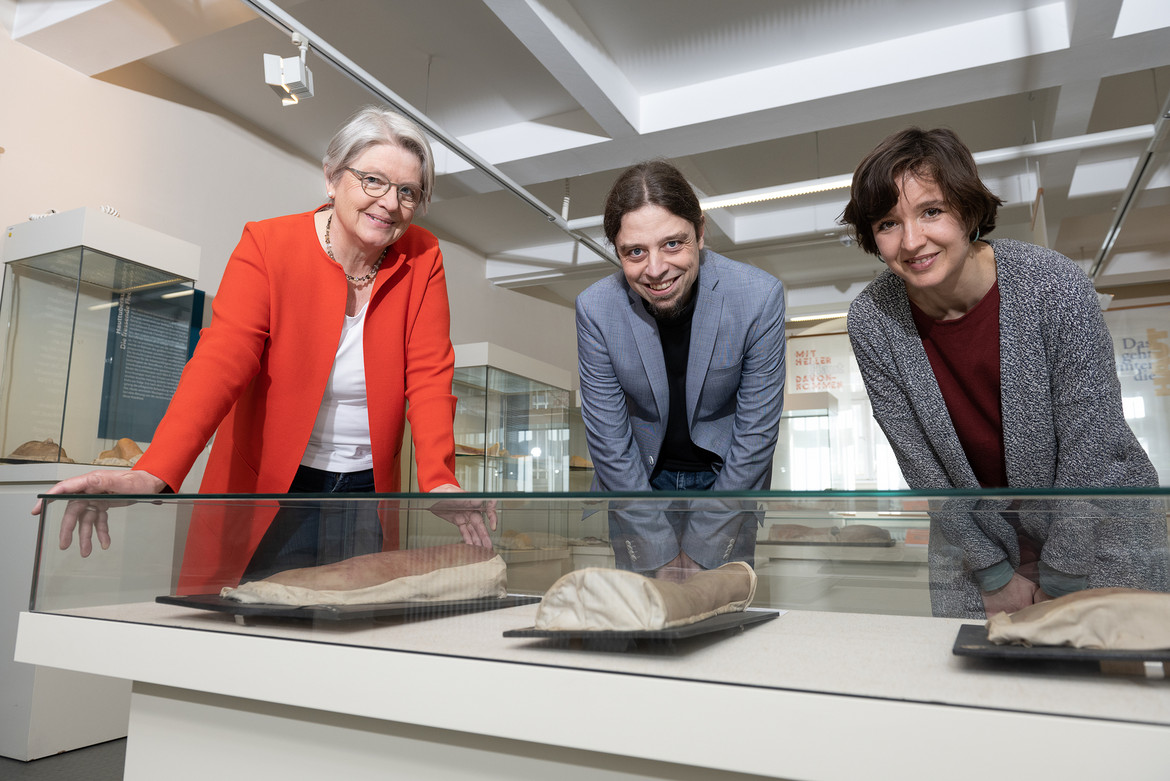
The Institute for Ethics and History of Medicine houses two important medical history teaching collections, which are open to the public as permanent exhibitions:
The collection on the history of obstetrics and the moulage collection.
Visits to the exhibitions outside opening hours and guided tours are possible by arrangement: 0551 3969007.
Öffnungszeiten Bibliothek und Sammlungen
Öffnungszeiten:
Di + Mi 09:00-16:30 Uhr
Do 09:00-12.30 Uhr
The collection on the history of obstetrics
When a maternity hospital was established in Göttingen in 1751 on the initiative of Albrecht von Haller, it was one of the first university maternity clinics.
For the purpose of scientific documentation and as illustrative material for teaching, Johann Heinrich Fischer (1759-1814) started a small collection of specimens as early as 1785. This collection was significantly expanded by subsequent directors Friedrich Benjamin Osiander (1759-1822) and Eduard Kaspar Jacob von Siebold (1801-1861), supplemented with instruments and models, and at its peak numbered around 5,000 objects. Today, around 1,200 objects remain, including wax models with anatomical representations of women, forceps and lever forceps, guide rods and turning rods, a replica of Stein's birthing chair, various models of birthing beds, and equipment for postnatal care.
Particularly impressive exhibits have been on display since 1995 in the permanent exhibition curated by midwife and ethnologist Dr. Christine Loytved. In addition, our institute is fortunate to have in its possession not only this important collection, but also the detailed birth records of the first clinic directors and other valuable archival materials from the early days of academic obstetrics.
Moulage collection
Moulages are wax casts of pathological changes in body regions and skin areas that are accurate in size, shape, and color. In the first half of the 20th century, they were primarily used as medical teaching and study aids. Dermatology and venereology made particularly good use of the possibility of lifelike wax casts of patients for their emerging field.
Many clinics, including the Polyclinic for Skin and Venereal Diseases founded in Göttingen in 1917, therefore built up extensive collections. One of the most important collections of moulages still preserved in the German-speaking world is that of the Göttingen Skin Clinic, which is now kept at the Institute for Ethics and History of Medicine. The nearly 80 moulages, most of which are well preserved and of high quality, were produced mainly in the 1920s and 1930s and, in addition to various other skin diseases, essentially depict findings of the then widespread diseases syphilis, gonorrhea, and tuberculosis.
In the second half of the 20th century, the art of moulage temporarily fell into oblivion as an outdated means of documentation, but is currently experiencing an astonishing renaissance. The medical and cultural history exhibition “Wachs-Bild-Körper” (Wax-Image-Body), a collaborative project between the Institute for Ethics and History of Medicine, the Göttingen Dermatology Clinic, and the Municipal Museum, reflects this renewed interest. It was initiated and curated by nurse and cultural anthropologist Dr. Susanne Ude-Koeller, contextualized with additional exhibits and texts, and was first presented to the public in 2007 at the Municipal Museum of Göttingen. Based on this presentation, the permanent exhibition was opened at our institute in 2011. The exhibition provides visitors with impressive insights of various kinds, as it focuses not only on diseases but also on patients and the skin as the human body's outer covering.