

Services Offered by the Institute
The Institute offers a range of services in the fields of medical ethics and history. These include a specialized ➜ reference library, an ➜ exhibition of two medical history teaching collections, and the ➜ Information and Documentation Center for Ethics in Medicine (IDEM).
Kornelia Drost-Siemon
Telefon: +49 (0)551 39 69007
E-Mail: kdrost(at)gwdg.de
🕘Library and Collection Hours
Tuesday & Wednesday: 9:00 a.m. – 4:30 p.m.
Thursday: 9:00 a.m. – 12:30 p.m.
Reference Library

Our reference library has a total collection of approximately 26,000 volumes, including 43 current journals. This makes it one of the leading specialized libraries in Germany. In cooperation with the “Academy of Ethics in Medicine. Professional Association for Ethics in Healthcare (AEM),” the collection has focused on the field of “Ethics in Medicine” since 1998. The library is open to students of all disciplines, researchers, and anyone interested in the ethics and history of medicine.
➜ Institute Catalog ➜ Apply for a Library Card.
💻 Workspaces
The library has ten workstations, six of which have power outlets. These can be used after informal registration.
📸 Copying
Scanning and copying services are available (scans are free; A4 copies cost 5 cents) on the 1st floor of the institute.
Exhibition on the History of Medicine
The And the team at the Department of Medical Ethics and History of Medicine houses two significant educational collections on the history of medicine, which are open to the public as part of a permanent exhibition on the history of medicine: the Collection on the History of Obstetrics and the Moulage Collection.
Visits to the exhibitions outside of regular opening hours and guided tours are available by appointment.
Collection on the History of Obstetrics
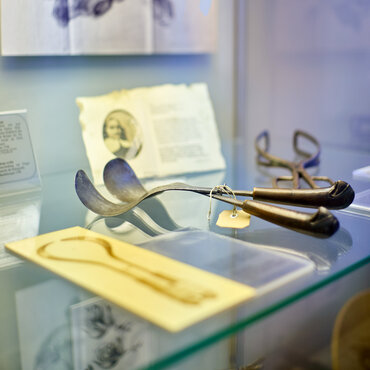
With the Accouchieranstalt, founded in 1751 on the initiative of Albrecht von Haller, Göttingen was among the earliest university maternity clinics. As early as 1785, Johann Heinrich Fischer established a collection of specimens for research and teaching, which was significantly expanded by his successors Friedrich Benjamin Osiander and Eduard Kaspar Jacob von Siebold and at times comprised around 5,000 objects. Today, approximately 1,200 items have been preserved, including anatomical wax models, historical obstetric instruments, a replica of Stein’s delivery chair, as well as models and devices for obstetrics and postpartum care. A selection has been on display in a permanent exhibition since 1995. The collection is supplemented by extensive birth records and other archival materials from the early days of academic obstetrics.
Moulage Collection
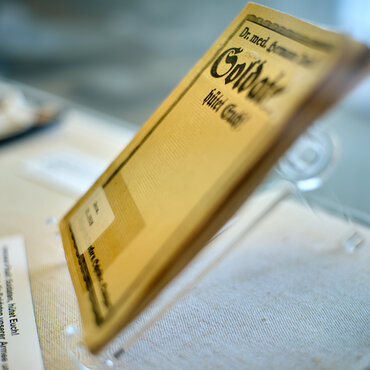
Moulages are highly detailed wax casts of pathologically altered body and skin areas that served primarily as teaching and study objects in the first half of the 20th century. They were used, particularly in dermatology and venereology, to vividly document clinical presentations.
The Göttingen Polyclinic for Skin and Venereal Diseases, founded in 1917, also built up an extensive collection. The collection, now housed at the And the team at the Department of Medical Ethics and History of Medicine, comprises around 80 high-quality moulages from the 1920s and 1930s, including depictions of syphilis, gonorrhea, tuberculosis, and other skin diseases. After a period of waning interest, the art of moulage is once again gaining attention; a permanent exhibition at the institute presents the objects in a medical and cultural-historical context.
Information and Documentation Center for Medical Ethics (IDEM)
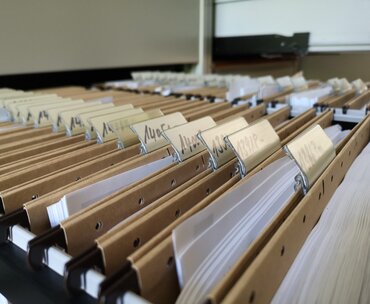
The Information and Documentation Center for Medical Ethics (IDEM) is operated by the And the team at the Department of Medical Ethics and History of Medicine in cooperation with the ➜ Academy for Medical Ethics (AEM) and is funded by the University Medical Center Göttingen.
IDEM’s primary mission is to develop and maintain the medical ethics literature database ➜ ETHMED. It contains well over 20,000 records and can be used free of charge for research. Through the ➜ LIVIVO Search Portal for the Life Sciences—a product of ZB MED, the Information Center for the Life Sciences—ETHMED can be searched in conjunction with other databases; this is also possible via the ➜ German Reference Center for Ethics in the Life Sciences.
Further information can be found on the ➜ IDEM website.
You might also be interested in