
Preparing Primary Care for Alzheimer’s Disease Risk Communication: Ethical Implications of Early Detection (PREPARE)

Subproject 1: Ethical implications of early detection of Alzheimer’s disease
Funding:
Bundesministerium für Forschung, Technologie und Raumfahrt (BMFTR) (01GP2213A)
Funding Amount:
896.531 EUR (Overall Project)
Duration:
08/2023 - 07/2026
Project Participants:
- Dr. Julia Perry – Principal Investigator and Coordinator
- Prof. Dr. Silke Schicktanz – Principal Investigator
- Jana Wegehöft, M.A. – Research Associate
Project partners:
- Deutsches Zentrum für Neurodegenerative Erkrankungen (DZNE), Greifswald (Prof. Dr. Jochen René Thyrian – PI SP2)
- Deutsches Zentrum für Neurodegenerative Erkrankungen (DZNE), Bonn (Prof. Dr. Anja Schneider – PI SP3)
- Harding-Zentrum für Risikokompetenz, Universität Potsdam (Dr. Felix G. Rebitschek – PI SP4)
Research Background
Recent developments in blood-based biomarker tests designed to support the early diagnosis of Alzheimer’s disease (AD) have the potential to improve initial diagnostic processes in healthcare.
Their future implementation in routine care for AD also involves ethical challenges and risks. Before blood-based biomarkers are used in medical care, it becomes necessary to determine the clinical and personal risk-benefit ratio in the context of preventive and therapeutic options, as well as potential psycho-social impacts, such as social stigmatization or discrimination. As primary care physicians are often the first point of contact for individuals with memory complaints, they are viewed as a relevant target group for counseling on blood-based biomarkers. However, the willingness of primary care physicians to provide such counseling is currently unclear and requires empirical evidence.
Research Content
In the interdisciplinary PREPARE project, we are conducting theory-driven and empirical research focusing on how blood-based biomarkers can be implemented in in primary care in a patient-centered and ethically sound manner.
Within four subprojects, PREPARE collects, analyzes, and reflects on empirical data from primary care physicians, patients, and their relatives. Concretely, the subprojects examine the attitudes, communication needs, experiences, and perspectives of primary care physicians, as well as of patients and their relatives, regarding the assessment of AD risk. Further, the project examines the ethical, social, and health policy implications arising from various future scenarios regarding the use of blood-based biomarkers, as well as the measures necessary to integrate such technologies into healthcare responsibly. Within the project, we are developing an interactive risk communication tool that can support informed and shared decision-making during physician-patient consultations.
Research Aims
- An interactive risk communication tool to support the consultation process when deciding for or against blood-based biomarker testing
- Clinical communication guidelines for decision making during the physician-patient consultation
- Additional (visual) materials for primary care providers and the interested public
Outreach
- Quiz on blood-based biomarkers for AD Nacht des Wissens 2025
- Perry, J., Radenbach, K., Geschke, K., & Rostamzadeh, A. (2024). Counseling and disclosure practices in predictive Alzheimer’s disease diagnostics: A scoping review. Alzheimer’s & Dementia: The journal of the Alzheimer’s Association, 20(12), 8910–8936. DOI: 10.1002/alz.14365
- Wegehöft, J., Schicktanz, S., & Perry, J. (2026). Ethische Aspekte einer Testung auf Demenzrisiko. In: Pantel, J., Teipel, S. & Frölich, L. (Eds.). Neue Therapien der Alzheimer-Krankheit. W. Kohlhammer GmbH. DOI: 10.17433/978-3-17-045400-2
- Recruitment of primary care physicians to our online survey
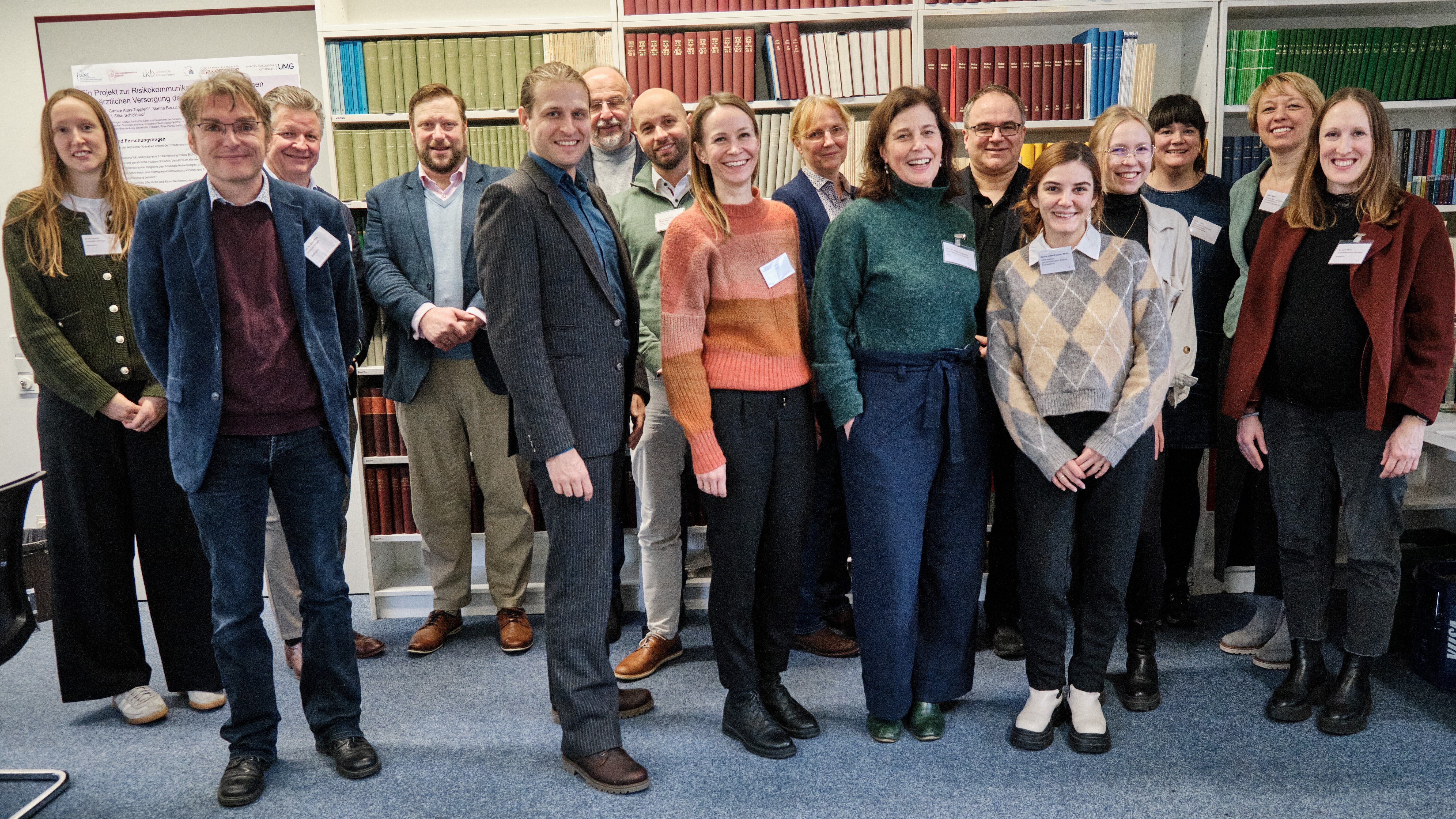
- The scenario workshop team „Zwischen Screening und individueller Nachfrage blutbasierter Biomarkertests zur Alzheimer-Früherkennung: Interdisziplinäre Zukunftsvisionen für die Primärversorgung“ is currently submitting a paper to a peer-reviewed journal
Subprojects
Subproject 1:(University Medical Center Göttingen)
Ethical implications of early detection of Alzheimer’s disease
Subproject 2 (DZNE Greifswald)
Empirical analysis of GPs’ attitudes, needs and knowledge
Subproject 3 (DZNE Bonn)
Empirical analysis of patients’ attitudes, needs and knowledge
Subproject 4 (Harding Center for Risk Literacy)
Personalized risk communication for risk prediction
Cooperation partners (Department of General Medicine/Ruhr University Bochum)