
Our courses
Experienced and dedicated faculty members teach within the medical curriculum. We offer the following courses:
- Medical Terminology (1st semester),
- the interdisciplinary course History, Theory, and Ethics of Medicine (GTE) (spanning the 5th, 9th and 10th semesters), as well as
- the Research Ethics module.
An elective seminar titled Current Topics in Medical Ethics is also offered during the winter semester, which is also open to students of the Faculty of Philosophy and Social Sciences (please refer to the current announcements). In the dentistry program, we teach the exam-relevant course Ethics in Dentistry. In the BA program in Molecular Medicine, we offer the seminar Ethics in the Life Sciences.
Medical Terminology (Medizinische Terminologie)
Semester: 1st semester | Course language: German | Assessment: Written exam | Contact: Dr. Tatjana Weber
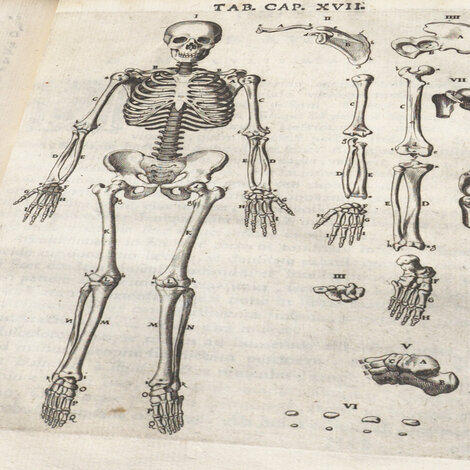
Course Content
Medical practice is inextricably linked to language. Every medical history, every scientific publication, and every instance of interprofessional communication requires a precise and thoughtful use of terminology. This course introduces you to the fundamentals of medical terminology and provides a solid understanding of key terms.
Please send your request for equivalency certificates (Äquivalenzbescheinigungen) via email to the secretary’s office for processing.
Skills You Will Acquire
Through lectures, self-study, and online materials, you will learn to systematically acquire and confidently apply the relevant vocabulary and technical terms.
History, Theory, and Ethics of Medicine (Geschichte, Theorie, Ethik der Medizin)
Schedule: Continuous | Course Language: German | Assessment: Written Exams | Contact: Dr. Tatjana Weber
Interdisciplinary Module 2 GTE is encountered by students at various points throughout their medical studies. However, the courses described below are to be viewed as a single unit. Attendance is mandatory. The two largest courses in Module 1.1 (GTE I) and Module 6.1 (GTE II) are combined into a single assessment. The course content of the other courses is assessed as part of the respective module exams.
Course Content
GTE I in Module 1.1 “Basic Medical Skills and Fundamental Knowledge”
Students participate in four seminar sessions over a period of four weeks. Seminars are offered on various topics, such as eugenics and human genetics, the history of psychiatry, the treatment of infectious diseases, and how the social and ethical objectives of medicine and research have changed over time.
Using these topics as examples, the seminars address fundamental questions and principles of the history of medicine and health-related disciplines, as well as their implications for contemporary medical ethics.
GTE II “Medical Ethics” in Modules 2.4, 5.1, 5.3, and 6.1
Module 2.4
In this module, a brief class session covers fundamental questions and ethical aspects of research involving humans and animals, as well as good scientific practice. Students learn about the most important ethical principles of academic work, relevant from the planning of a study and the recruitment of research participants through to the publication of research results. Topics include, among others, dealing with scientific misconduct (e.g., plagiarism) and submitting ethics applications. The lecture is also of particular importance for writing a medical doctoral dissertation.
Module 5.1
In Module 5.1, “The Nervous System and the Mind,” a course unit introduces the topic of patient self-determination. It covers the significance of the right to self-determination, the concepts of capacity to consent, legal capacity, and testamentary capacity, surrogate consent, and the question of the limits of self-determination. Another teaching unit, Law and Forensics II, is carried out jointly with faculty from the Department of Forensic Psychiatry. The focus is on ethical issues in forensic psychiatry, particularly regarding forensic commitment. The topic of patient self-determination is addressed and explored in greater depth in Module 6.1.
Module 5.3
This course unit addresses ethical issues in the context of modern reproductive medicine as well as the handling of intersex and transgender issues. The course is integrated into the clinical module on diseases of the reproductive organs and comprises two 90-minute lectures and a 90-minute case seminar (the case seminar is compulsory), as well as approximately 120 minutes for reading assigned texts and self-study. Topics covered include ethical issues in modern gynecology, obstetrics, and reproductive medicine (e.g., IVF, abortion, the moral status of the embryo and fetus, etc.), as well as disorders/variations in sexual development (intersex) and transgender identity.
Module 6.1
In this module, the GTE course deepens students’ knowledge of medical ethics and trains them in ethical decision-making. It consists of four two-hour lectures and four corresponding case seminars, as well as in-depth self-study using online literature. In the 90-minute case seminars (with compulsory attendance), challenging ethical cases from everyday clinical practice are examined, and potential solutions are discussed. The exact schedule will be communicated during the first session and via an additional agenda posted on Stud.IP. The course topics address key clinical and practical issues of current social relevance:
- Fundamentals of medical ethics: legal and ethical aspects of patient self-determination; dealing with patients with limited decision-making capacity (e.g., children)
- Transplant medicine, organ donation, organ allocation
- Withdrawal of treatment; end-of-life decisions
- Economization in healthcare; equitable distribution of scarce resources.
What Skills You Will Acquire
You will develop an awareness of the historical and societal dimensions of medical practice and gain a deeper understanding of how current issues in modern medicine are also shaped by historical and political contexts. At the same time, you will strengthen your ability to critically analyze and reflect on medical theories and practice. This compulsory seminar lays the foundation for further engagement with the history, theory, and ethics of medicine.

Ethics in the Life Sciences (Ethik in den Lebenswissenschaften)
Start: Winter Semester | Course Language: German & English | Assessment: Presentation | Contact: Dr. Nitzan Rimon-Zarfaty

Course Content
Advances in the life sciences enable new therapeutic possibilities while simultaneously raising fundamental ethical questions. This seminar introduces students to key positions, lines of argumentation, and controversies in bioethics and provides a systematic approach to moral issues in medicine and biomedical research. The focus is on current, socially relevant topics. The goal is to enable students to engage in independent and critical reflection on bioethical debates. The course takes place in person during the winter semester. The schedule and syllabus will be announced at the beginning of the course or via Stud.IP. BA students in Molecular Medicine should register via Stud.IP (self-registration); medical doctoral students should register by email by October 11.
Skills You Will Acquire
You will learn to analyze ethical issues in the life sciences in a structured manner, critically evaluate lines of argumentation, and formulate well-reasoned judgments. In doing so, you will develop the ability to reflect on complex moral conflicts from different perspectives.
Interdisciplinary Area: Health Sciences and Ethics in Dentistry (Querschnittsbereich Gesundheitswissenschaften und Ethik in der Zahnmedizin)
Schedule: 9th semester of dentistry │ Course language: German │ Assessment: oral exam │ Contact: Dr. Tatjana Weber
Course Content
The course Ethics in Dentistry is intended for dental students. In a 90-minute session, we teach fundamental knowledge of medical ethics issues is taught using a practical case study. The focus is on topics such as capacity to consent and patient autonomy, legal and ethical criteria for the treatment of minors, and principle-based ethical decision-making in conflict situations. Assessment takes place as an oral exam. All course content, including the provided materials, is relevant to the exam.
Skills You Will Acquire
You will learn to identify, reflect on, and analyze ethical issues in everyday clinical practice. You will learn to incorporate different perspectives – such as those of patients, healthcare providers, and family members – into your decision-making. In addition, you will learn to justify decisions while taking ethical principles into account. The goal is to equip you to act responsibly in your future professional prac-tice.
You might also be interested in